
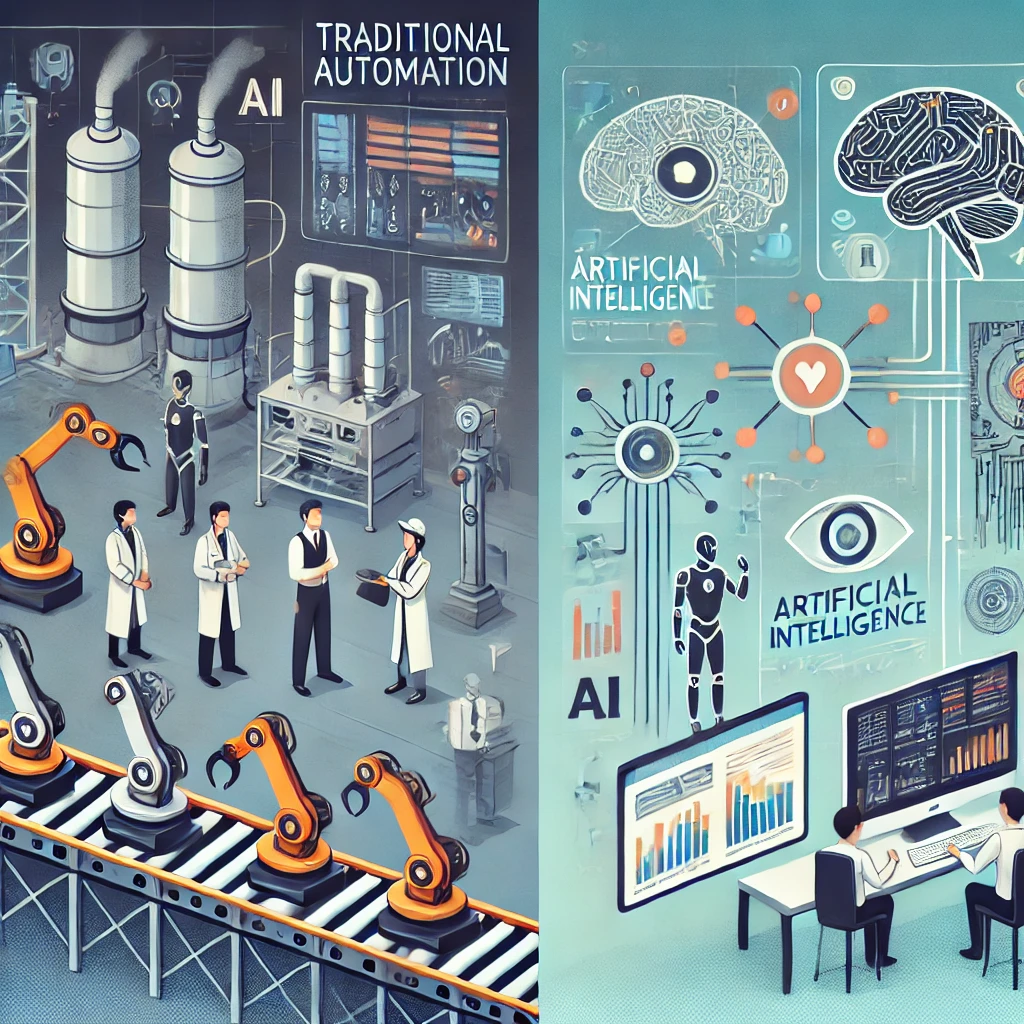
In today’s fast-paced digital world, businesses are constantly seeking innovative solutions to optimize processes, reduce costs, and improve efficiency. Two major technological approaches leading this transformation are Artificial Intelligence (AI) and Traditional Automation. While both aim to streamline workflows and enhance productivity, they operate in fundamentally different ways and serve distinct purposes.
In this blog post, we’ll break down the key differences between AI and traditional automation, explore their unique advantages, and help you determine which solution is right for your business.
What is Traditional Automation?
Traditional automation refers to the use of pre-programmed rules and scripts to perform repetitive tasks without human intervention. Think of it as following a strict “if-this-then-that” logic.
Key Features of Traditional Automation:
- Rule-Based: Operates on fixed, pre-defined instructions.
- Predictable: Delivers consistent results for repetitive tasks.
- Limited Flexibility: Struggles with exceptions or changes in workflow.
- Use Cases: Data entry, payroll processing, invoice generation, assembly lines.
Example: In a manufacturing plant, a conveyor belt system that moves products from one station to another is a form of traditional automation. It performs the same task repeatedly, without adapting to new conditions.
What is Artificial Intelligence (AI)?
Artificial Intelligence, on the other hand, simulates human intelligence by enabling machines to learn, reason, and make decisions. AI can process vast amounts of data, identify patterns, and improve its performance over time.
Key Features of AI:
- Data-Driven: Learns from data to make informed decisions.
- Adaptable: Can handle complex, non-repetitive tasks and adapt to new situations.
- Self-Improving: Uses techniques like machine learning to enhance its capabilities over time.
- Use Cases: Chatbots, predictive analytics, image recognition, fraud detection.
Example: An AI-powered chatbot that understands customer queries, learns from previous interactions, and provides relevant solutions, even if the phrasing of the question changes.
Key Differences Between AI and Traditional Automation
| Aspect | Traditional Automation | Artificial Intelligence (AI) |
|---|---|---|
| Approach | Rule-based, pre-programmed logic | Data-driven, adaptive learning |
| Flexibility | Limited to predefined scenarios | Can handle complex and changing environments |
| Cognitive Abilities | None – follows strict rules | Mimics human-like reasoning and decision-making |
| Scalability | Difficult to scale for complex tasks | Easily scalable with more data and computing power |
| Error Handling | Struggles with exceptions | Can detect anomalies and adjust strategies |
| Example Use Cases | Assembly lines, data migration, report generation | Fraud detection, recommendation engines, virtual assistants |
When to Use Traditional Automation vs. AI
Use Traditional Automation when:
- Tasks are repetitive and rule-based.
- Consistency and speed are required.
- There is little to no variability in the process.
- Use AI when:
- Tasks require learning, adaptation, or decision-making.
- You need to process large volumes of unstructured data.
- The process involves complex interactions or predictions.
Can AI and Traditional Automation Work Together?
Absolutely! In fact, many businesses integrate both technologies in what’s known as Intelligent Automation or Hyperautomation. This approach combines the consistency of traditional automation with the adaptability of AI.
Example: In customer support, traditional automation can route tickets to the appropriate departments, while AI chatbots handle complex customer queries and improve responses over time.
Final Thoughts
While traditional automation and AI serve different purposes, they are not mutually exclusive. Traditional automation is ideal for structured, repetitive tasks, while AI thrives in environments that require data analysis, learning, and adaptability.
By understanding the strengths and limitations of both, businesses can develop tailored solutions that maximize efficiency, reduce costs, and enhance customer experiences.